Identification Description Regulatory Status Usage Natural occurrence
|
Produkto pavadinimas: |
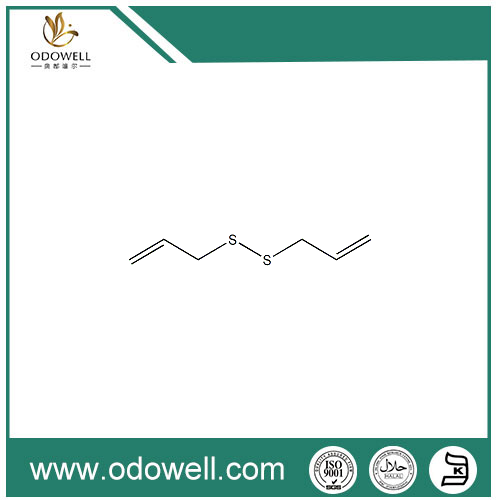
Dialilo disulfidas |
|
Sinonimai: |
DYALLYLDISULFIDE;DI(2-PROPENYL)DISULPHIDE;DIALLYL DISULFIDE: TECH., 80%;ALLYL DISULFIDE;ALLYL DISULPHIDE;2-PROPENYL DISULPHIDE;FEMA 2028;DIALLYL DISULFIDE |
|
CAS: |
2179-57-9 |
|
MF: |
C6H10S2 |
|
MW: |
146.27 |
|
EINECS: |
218-548-6 |
|
Produktų kategorijos: |
sulfido skonis |
|
Mol failas: |
2179-57-9.mol |
|
|
|
|
Virimo temperatūra |
180–195 °C (liet.) |
|
tankis |
1.008 g/mL at 25 °C(lit.) |
|
garų tankis |
>5 (palyginti su oru) |
|
garų slėgis |
1 mm Hg (20 °C) |
|
lūžio rodiklis |
n20/D 1,541 (liet.) |
|
FEMA |
2028 | ALILIO DISUFIDAS |
|
Fp |
144°F |
|
laikymo temp. |
2-8°C |
|
forma |
aliejus |
|
spalva |
bespalvis iki geltonos spalvos |
|
Kvapas |
Diallyl disulfide is an essential odor component of garlic oil. |
|
Pavojaus kodai |
Xn, Xi |
|
Rizikos pareiškimai |
22-36/37/38-10 |
|
Safety Statements |
26-36/37/39-37/39-16-36 |
|
RIDADR |
JT 2810 6.1/PG 3 |
|
WGK Vokietija |
3 |
|
RTECS |
1000000 BB |
|
F |
13 |
|
TSCA |
Taip |
|
Pavojaus klasė |
6.1 |
|
Pakavimo grupė |
II |
|
HS kodas |
29309090 |
|
Hazardous Substances Data |
2179-57-9(Hazardous Substances Data) |
|
Aprašymas |
Allyl disulfide has a characteristic garlic odor. It is used as a flavor enhancer, flavoring agent or adjuvant. |
|
Naudojimas |
Reported uses (ppm): (FEMA, 1994)
Maisto kategorija Įprasta Maks. Alcoholic beverages 0.1 1 Kepiniai 9.09 13.16 Condiments, relishes 13.82 15.21 Šaldytas pienas 0.1 1 Gelatins, puddings 0.5 1 Gravies 2 6.5 Mėsos gaminiai 9.4 13.1 Nonalcoholic beverages 0.07 0.68 Minkšti saldainiai 0.5 1 Sriubos 1 10 |
|
Natūralus reiškinys |
Main constituent of Allium sativum essential oil. Reported found in onion (Allium cipa, L.), garlic (Allium sativum L.), chive (Allium schoenoprasum L.), nira (Allium tuberosum rottl.), raw cabbage and caucas (Allium victoralis L.). |
|
Cheminės savybės |
SVARSUS GELTONAS SKYSČIS |
|
Cheminės savybės |
Allyl disulfide has a characteristic garlic odor. It is used as a flavor enhancer, flavoring agent or adjuvant |
|
Atsiradimas |
Main constituent of Allium sativum essential oil. Reported found in onion (Allium cipa, L.), garlic (Allium sativum L.), chive (Allium schoenoprasum L.), nira (Allium tuberosum rottl.), raw cabbage and caucas (Allium victoralis L.). |
|
Naudoja |
antineoplastic, antibacterial, apoptosis inducer, insecticide |
|
Naudoja |
Diallyldisulfide has a range of uses varying from a Cytocrome P450 inhibitor to vasorelaxant and hypotensive. Being in the class of organosulfur compounds, it carries chemopreventive characteristics . |
|
Apibrėžimas |
ChEBI: An organic disulfide where the organic group specified is allyl. It has been isolated from garlic and other species of the genus Allium. |
|
Pasiruošimas |
By oxidation of allyl mercaptan with iodine in the presence of pyridine and ethanol; from sodium allyl thiosulfate with potassium hydroxide. |
|
Aromato slenkstinės vertės |
Detection: 4.3 to 30 ppb; Recognition: 80 ppb |
|
Skonio slenkstinės reikšmės |
Taste characteristics at 2 ppm: green onion and garlic-like with meaty nuances |
|
Susisiekite su alergenais |
Diallyldisulfide is one of the major allergens in garlic (Allium sativum) and onions. Among patients patch-testpositive to garlic, all 13 who were tested had positive reactions to diallyl sulfide 5% pet. |
|
Valymo metodai |
Purify the disulfide by fractional distillation until the molar refractivity is in uniformly good agreement with the calculated value [Small et al. J Am Chem Soc 69 1710 1947]. It has also been purified by gas chromatography [retention times: Carson & Wong J Org Chem 24 175 1959, UV: Koch J Chem Soc 395 1949]. It is present in garlic. [Beilstein 1 IV 2098.] |
|
Žaliavos |
Alilo merkaptanas |